
Content
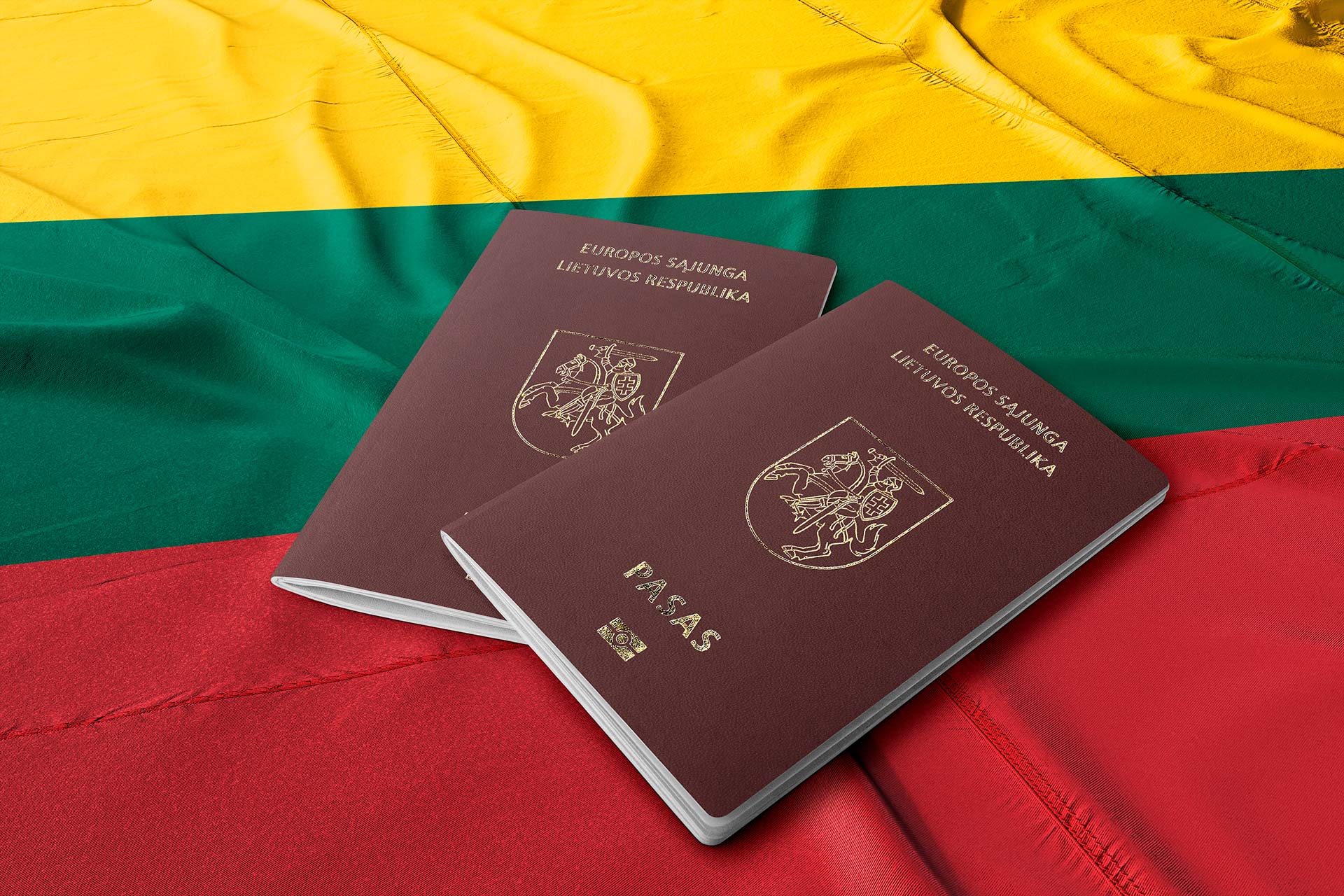
Lithuanian citizenship confers upon a foreign national all the benefits of holding the legal status of a European Union member state. A national passport allows you to live, work, run a business, and study in any of the 27 EU countries without obtaining a separate residence permit.
You can acquire Lithuanian citizenship by naturalization, by being born to a Lithuanian parent, on the basis of descent, or for exceptional services rendered to the country. Applicants must master the state language and understand the fundamentals of the Constitution.
Under the Law «On Citizenship», one may apply for a Lithuanian passport after 5–10 years of uninterrupted residence in the country, except in cases of birthright citizenship or restoration of status. Applicants must be adults and have no criminal convictions in their country of origin. Obtaining a Lithuanian passport grants the holder EU citizenship. For more details on each pathway to a national identity document of the Republic of Lithuania, see the full article.
What a Lithuanian Passport Provides
- The right to live, work, and conduct business freely in any EU country.
- The ability to open accounts and access banking services across Europe, including mortgages on preferential terms.
- The right to participate in Lithuania’s electoral processes.
- Free-trade privileges within the European Union and with Iceland, Norway, Liechtenstein, Switzerland, and Singapore.
- Access to higher and specialized education at EU universities on the same terms as local students.
- Visa-free or electronic-authorization travel to 173 countries, including Canada, Japan, Israel, Hong Kong, Mexico, South Korea, the United Kingdom, and the United States.
- Access to healthcare services in any EU member state under a unified insurance policy.
Who Can Apply for Lithuanian Citizenship
Lithuanian citizenship is available to persons who legally reside in the country, have no criminal record, have passed an exam in the state language and the basics of the Constitution, and have sufficient means of subsistence. You may apply for a Lithuanian passport by:
- Standard or simplified naturalization.
- Ethnic origin.
- Birth to a Lithuanian citizen.
- Special merits rendered to the state.
For citizens of post-Soviet countries, some EU member states (including Lithuania) offer a simplified repatriation program, allowing them to obtain an EU passport within about 12 months.
Methods of Obtaining Lithuanian Citizenship
The procedure for acquiring a national passport varies by applicant category:
By Business Activity
Foreigners who have established a company in Lithuania or purchased shares in an existing company may first obtain temporary residence for 2 or 3 years.
Proof of commercial activity includes company registration documents, the articles of association, or a share-ownership certificate.
Immigration via entrepreneurship generally requires a minimum investment of €28 000. Startup founders must also submit a business plan and demonstrate relevant qualifications or experience.
Family members of the primary permit holder may apply for temporary residence once the main applicant’s status is granted.
By Investment
Significant investments in Lithuania’s economy permit a foreigner to move legally, obtain temporary residence (TN), permanent residence (PR), and—after 10 years—apply for citizenship.
Both individuals and companies (including their employees or shareholders) may invest in securities, long-term tangible or intangible assets. Investments in defense, national security, or lottery operations are prohibited.
The minimum qualifying investment is €1 448 100; TN is issued for 3 years. Applicants must sign an investment agreement for a term equal to or exceeding the permit’s duration and maintain the investment throughout the 10-year period to become eligible for citizenship.
By Employment
Foreigners hired by a Lithuanian company or research institution may request TN based on an employment contract or official hiring order.
Prior to issuing the TN, the employer must obtain approval from the local labor exchange for filling the vacancy with a non-EU candidate.
Family members may apply for TN after the employee has worked officially in Lithuania for 2 years.
Highly qualified specialists with at least 5 years’ experience and a salary of 1.2–1.5× Lithuania’s average gross wage (from €2 352/month) can apply for an EU Blue Card. Their family members may apply alongside them. After 10 years’ continuous residence, they may pursue citizenship.
As a Refugee
A person persecuted in their home country on grounds of race, religion, nationality, politics, or social opinion may apply for international protection in Lithuania.
The application (for the principal and family members) is filed with the Migration Department.
While the claim is processed, the state provides housing, food, and other assistance.
Upon approval, refugees receive a 5-year PR card, renewable thereafter, and may apply for Lithuanian citizenship after 10 years’ residence.
To discover new opportunities with EU citizenship
By Descent
Persons whose ancestors held Lithuanian citizenship may apply for the Republic’s passport on this basis. When filing the application, they must submit birth or marriage certificates of their parent, grandparent, or great-grandparent. Those with Lithuanian heritage receive permanent residence (PR) initially and may request citizenship after 5 years.
Additionally, foreign nationals whose ancestors—or who themselves—lived in Lithuania before June 15, 1940, and can prove it, may first obtain long-term resident status and later apply for a passport. If the applicant was born in Lithuania, they can restore their birth certificate and immediately receive citizenship. If the applicant’s ancestors lived in Lithuania, they qualify for PR and, after 5 years of residence, may request a national passport.
By Birth
Children of Lithuanian citizens acquire this status automatically if one or both parents are nationals of the Republic. If the child is born abroad, the nationality «Lithuanian» may be recorded in the birth certificate upon request of either parent. Stateless children legally residing in Lithuania may also obtain the Republic’s legal status.
By Exceptional Merits
Lithuanian citizenship is available to foreign nationals who have made a significant contribution to enhancing the Republic’s international standing. This pathway applies to outstanding achievements in sports, culture, the arts, or scientific and research activities. The naturalization process for this category does not require the usual immigration stages (temporary and permanent residence). However, the applicant must demonstrate integration into society—knowledge of the language, familiarity with national customs, and ongoing professional activity benefiting the Republic.
How to Obtain Lithuanian Citizenship
- Choosing Your Basis.
You can immigrate to the Republic by various routes, each determining the subsequent process for obtaining resident status and citizenship. At this initial stage, applicants should consult with immigration lawyers who will help select the most suitable option. Specialists will take into account all nuances of the applicant’s personal situation, as well as any family members and possible paths for joint relocation. - Apply for a National D-Type Visa.
You must request authorization for entry and long-term stay (from 3 to 12 months) at the Lithuanian consular post in your place of residence. The immigration visa is issued upon presentation of a document confirming your right to stay in the country. When submitting your application, you pay a consular fee of €140. A D-type visa is granted within 15–45 days. - Obtain a Temporary Residence Permit (TRP).
Submit your documents for a Lithuanian TRP at a branch of the Migration Department 2–4 months before your D-visa expires. Applications are filed online via the official MIGRIS portal. At submission, you pay a state fee of €160–320 and provide fingerprints. Processing takes 45–90 calendar days. Extensions follow the same procedure, with a fee of €45–90 (standard or expedited service). - Obtain Permanent Residence (PR).
As a TRP holder, you apply and schedule an appointment online with the Migration Department. Before your visit, you must pass an exam on the state language and basic constitutional knowledge. At your appointment, you present your documents, have your photo and fingerprints taken, and pay a state fee of €160–320 (standard or expedited review). Processing takes 2–4 months, after which you receive your PR card. - Submit a Citizenship Application.
File your citizenship documents digitally and complete the naturalization application online via MIGRIS. Once submitted, you book an in-person appointment at a Migration Department office. There, you personally—or through an authorized representative—hand in your previously uploaded documents and pay a state fee of €120. Processing takes about 6 months. Upon approval, the President’s decree granting citizenship is published in the official Valstybės Žinios. - Take the Oath of Allegiance.
After the decree is issued, you must draft and notarize a renunciation of your previous citizenship. You then take the Lithuanian oath—no later than six months from the decree’s publication (for those required to renounce abroad, the deadline is two years). You become a Lithuanian citizen upon completion of the formal ceremony. - Obtain Your Identity Documents.
Request your Lithuanian ID card and national passport at the Migration Department. Production times range from 24 hours (expedited) to 30 days (standard). Fees are:- ID card: €8.60–31.60
Passport: €43–190

How to Prepare Documents for Lithuanian Citizenship
Before submitting your application dossier and naturalization request, any certificates or records issued outside Lithuania must be translated into the state language or English and notarized. The application is completed in the MIGRIS online system: documents are first uploaded digitally and then presented in original form. In addition to the application form, you must provide:
- A valid passport.
- Your permanent-residence card.
- A criminal-record certificate issued in your country of origin.
- Proof of uninterrupted residence in Lithuania for 5–10 years.
- Certificate of passing the exam in the state language and the basics of the Constitution.
- Proof of sufficient means of subsistence.
- Marriage certificate (if applicable).
- Notarized renunciation of previous citizenship.
- Receipt of payment for the state fee.
- Costs and Timeframes.
Obtaining Lithuanian citizenship by naturalization involves several stages: securing an immigration visa, temporary residence (TRP), permanent residence (PR), and finally citizenship. The standard path requires 10 years’ residence in the Republic, after which you file your naturalization application, take the oath, and receive Lithuanian identity documents. The overall process takes at least 11 years, accounting for processing times at each stage. The table below summarizes each legalization step and the associated official fees:
| Expense | Fee (€) |
|---|---|
| Consular fee for D-visa | 120 |
| TRP application | 120–240 |
| TRP renewal | 30–60 |
| PR application | 90–18 |
| Citizenship application | 53–120 |
| ID card issuance | 8.60–31.60 |
| Passport issuance | 43–190 |
Obtaining Lithuanian Citizenship Involves More Than Official Fees.
Relocating to, settling in, and living in Lithuania for at least five years requires substantially greater resources than just the government charges. Foreigners interested in alternative routes to EU citizenship should consult with immigration lawyers to explore all available options.
Dual Citizenship in Lithuania
The Lithuanian government has not concluded any bilateral agreements on dual citizenship. Accordingly, a foreign national seeking a Lithuanian passport must renounce their previous citizenship. Exceptions to this rule include:
- persons restoring their original status;
- children under 21 who acquired citizenship by birth or adoption;
- foreigners granted citizenship for exceptional merit;
- lithuanians under 21 adopted by citizens of another country, who automatically acquire a second nationality;
- spouses of Lithuanian citizens;
- refugees.
Where dual citizenship is permitted by law, the holder is regarded as Lithuanian while in Lithuania, and may use their other passport abroad at their discretion. The Lithuanian government does not notify foreign authorities when a person acquires Lithuanian citizenship.
Grounds for Refusal of Citizenship
Applications for Lithuanian citizenship may be denied for reasons such as:
- Violation of legal requirements during the application process.
- Acquisition of another country’s citizenship.
- Evidence that the applicant served in foreign armed forces.
- Failure of a Lithuanian citizen over 21 to renounce a second nationality.
- Provisions of international treaties.
Citizenship applicants must understand and comply with Lithuanian law throughout the process. Residence must be legal—based on temporary and permanent permits—and any unlawful stay will almost certainly result in refusal.
To navigate all the nuances of living in Lithuania, preparing documents, and completing formalities, applicants should seek professional assistance from experienced immigration specialists. With expert support, one can minimize the risk of refusal and successfully secure EU citizenship.
How to Secure All the Rights of a Lithuanian Citizen Quickly
Obtaining a Lithuanian passport is a lengthy process requiring each legal stage to be completed correctly. Foreign nationals wishing to accelerate their path—faster than the usual 6–11 years—can consider alternative immigration programs. Depending on one’s country of origin and personal circumstances, specialists can identify available schemes in various EU states that permit legal acquisition of an EU passport in as little as 12 months.
Content