Content
Immigration to Slovakia for non-EU citizens is subject to strict immigration requirements. Applicants must meet initial conditions regarding legal status, accommodation, and financial sufficiency.
For a relocation to Slovakia, an applicant is required to reside legally in the country for 5 years on the basis of a valid temporary residence permit. The processing time for long-term residence applications is typically around 90 days.
Alternatively, alternative immigration pathways are available within the European Union. In certain EU member states, citizenship can be acquired through simplified programs for eligible applicants. Depending on the specific program’s conditions, obtaining a second EU passport is possible within a relatively short timeframe, which automatically allows for moving to Slovakia or any other EU country.
Obtaining permanent residence in Slovakia requires strict compliance with legal frameworks, residency conditions, and documentation procedures. For this reason, many applicants seek assistance from immigration lawyers who can evaluate their eligibility, identify the optimal pathway, and guide them through the entire process of securing legal status in Slovakia and the EU.
Pros and Cons of Moving to Slovakia
Relocating to Slovakia offers foreign nationals a number of advantages, including:
- the right to reside within the European Union;
- access to employment opportunities with Slovak companies;
- access to public healthcare services through the state healthcare system;
- the right to apply for social assistance and benefits related to disability or low income;
- the opportunity to study in Slovak schools and universities under the same conditions as local citizens;
- the possibility of family reunification and obtaining residence permits for a spouse and children.
Foreign nationals considering a move to Slovakia should also take into account several potential disadvantages:
- the cost of living is generally higher than in many non-EU countries;
- most of the population communicates primarily in Slovak, while English is spoken mainly by younger generations;
- obtaining a Slovak residence permit requires compliance with a strict visa and immigration procedure.
Travel freely to over 170 countries
Possible Challenges When Relocating
The immigration process can be complex and requires full compliance with local legislation as well as a valid legal basis for residence in the country. Applicants should familiarize themselves in advance with the rights and responsibilities of residents in the Slovak Republic and review the experiences of other migrants who have already obtained temporary or permanent residence status.
It is also advisable to arrange accommodation before moving to the country. Renting a property remotely can be challenging, although local real estate agents may assist with the process. Since many applicants plan to settle in Slovakia on a long-term basis, acquiring at least a basic knowledge of the Slovak language is highly recommended. While younger people often speak English, middle-aged and older residents generally communicate only in Slovak. As part of the preparation for relocation, foreign nationals may benefit from enrolling in Slovak language courses before moving to the country.
Immigration Pathways
Immigration to Slovakia and obtaining permanent resident status begins with securing a visa and a residence permit based on employment, family reunification, or business activity. Time spent studying at a local university and residing in the country under a student residence permit is generally not counted toward the residence period required for permanent residence.
The most common ways to relocate to Slovakia for long-term residence differ in the validity period of the residence permit and the set of documents required for the application.
Business
Foreign nationals who plan to establish their own company in Slovakia and engage in commercial activities within the country may apply for a residence status on the basis of business activity. Applicants must not be employed under an employment contract either within or outside the European Union.
Residence permits for business purposes are issued for the expected duration of the business activity, but for no longer than 3 years at a time.
Employment
A residence permit is available to foreign nationals who have successfully completed a job interview and signed an employment contract with a Slovak employer. In such cases, the employer is generally required to obtain authorization to hire a worker from a non-EU country before the residence application can proceed.
The residence permit is issued for the duration of the employment contract, although the validity period of the document typically does not exceed 2 years. Residence in Slovakia based on seasonal employment is not counted toward the qualifying residence period required for obtaining permanent residence.

Family Reunification
Citizens and legal residents of Slovakia have the right to apply for family reunification on behalf of their spouses, minor children, and dependent parents. Status granted on this basis is generally issued for the same period as that of the principal applicant, but for no longer than 5 years.
If an application for a minor child is submitted by only one parent, a notarized consent from the other parent is generally required.
| Immigration Pathway | Validity of Residence Permit | Requirements |
|---|---|---|
| Business | Up to 3 years | A business plan for establishing a company and sufficient funds to support business activities |
| Employment | Up to 2 years | A valid employment contract with a Slovak employer and compliance with applicable work authorization requirements |
| Family Reunification | 1–5 years | Proof of family relationship, such as birth or marriage certificates, as well as evidence of sufficient financial means to support the family |
| EU Citizenship | Up to 5 years | Sufficient financial resources for self-support and a confirmed residential address in Slovakia |
The choice of immigration pathway for obtaining permanent residence in Slovakia directly affects both the timeframe and the complexity of the application process. A detailed immigration strategy and the most suitable option for acquiring EU citizenship can be discussed during an individual consultation with a specialist in international law. Professional legal support throughout the relocation process helps ensure full compliance with applicable legislation and significantly reduces the risk of an application being rejected.
Requirements for Applicants
Foreign nationals planning to relocate to Slovakia must meet the following requirements:
- have valid grounds for residing in the country and be able to provide official documentation supporting their purpose of stay;
- not pose a threat to the security, public order, or well-being of the residents of Slovakia;
- have owned or rented accommodation in Slovakia that is suitable for the number of family members who will reside there;
- possess sufficient financial resources to support themselves independently without relying on social assistance programs;
- maintain valid health insurance coverage for the entire period of their stay in the country.
The Process of Moving to Slovakia for Permanent Residence
For nationals of non-EU countries, the immigration process generally includes the following stages:
- Collecting the Required Documents.
Applicants need to obtain evidence supporting their grounds for relocation, such as an employment contract or a business plan for establishing a company. All documents must be translated into Slovak and notarized. Certificates and official documents issued by authorities in other countries must be apostilled where applicable. - Obtaining a Visa.
The applicant must schedule an appointment with the consular section of the Slovak embassy and attend in person to submit the documents required for an entry permit. A long-term Type D visa is issued after payment of the applicable state fee and grants the holder the right to enter Slovakia. - Obtaining a Residence Permit.
After arriving in Slovakia, the foreign national must visit the nearest police department and register an application for a biometric residence card. The processing period for a residence status application is generally up to 90 days. - Applying for Permanent Residence.
Foreign nationals who have legally resided in Slovakia for at least 5 years may apply for status with unlimited validity. Applications are typically reviewed within approximately 3 months. After 8 years of legal residence in the country, immigrants may become eligible to apply for Slovak citizenship through naturalization.
Required Documents
The permanent residence application dossier must be submitted to the competent regional office of the Ministry of the Interior responsible for the applicant’s place of residence. Applicants are generally required to provide the following documents:
- a valid passport;
- a completed application form available on the official website of the Slovak Ministry of the Interior;
- the original and a copy of a valid residence permit;
- two color photographs measuring 3 x 3.5 cm on a white background;
- a valid health insurance policy;
- proof of sufficient financial means, such as an employment contract, sponsorship letter, or a bank statement confirming the availability of funds to support residence in Slovakia.
Minor applicants must additionally provide a notarized consent for permanent residence issued by their parents or legal guardians. All documents included in the application dossier must be submitted together with a certified translation into Slovak.
Cost of Moving to Slovakia
Immigrating to Slovakia involves expenses related to document preparation, transportation costs associated with the move, and accommodation in the country. It is also important to take into account the cost of food, utility bills, and health insurance. If legal assistance is used during the immigration process, applicants should additionally budget for the services of immigration specialists.
Cost of Obtaining Permanent Residence
The main expenses associated with obtaining status in Slovakia include visa fees, residence permit application fees, document translation and certification costs, as well as the issuance of residence cards.
The fee for a long-term Type D visa remains approximately EUR 9.50. The application fee for a temporary residence status based on family reunification is approximately EUR 132.50–135, while a permit based on employment costs EUR 165.50 when submitted in Slovakia and EUR 170 when submitted through a Slovak embassy abroad. A temporary residence permit for business purposes costs approximately EUR 232–240, depending on where the application is filed.
The administrative fee for obtaining permanent residence is approximately EUR 165.50. The cost of issuing a residence card varies depending on the processing speed. Standard issuance generally costs between EUR 10 and 15, while expedited processing may cost up to EUR 39. Recent sources indicate that the older fee of EUR 4.50 is no longer generally applied for standard residence cards.
Applicants should also budget for certified translations, notarization, and apostille certification of documents. In most cases, translation costs start from EUR 20–30 per page, while the total cost of translation and notarial services for a complete application package often reaches EUR 200 or more, depending on the number of documents involved.
The overall cost of moving to Slovakia depends on the chosen immigration pathway and document preparation expenses. Residence permits require regular renewal and compliance with immigration regulations. For Turkish citizens, there is also a legal simplified pathway to obtaining a second passport without long-term residence or language requirements, providing access to the benefits of living, working, and doing business throughout the European Union.
Cost of Living in Slovakia
Housing remains the largest expense for most residents in Slovakia. Currently, renting a one-bedroom apartment in Bratislava typically costs between EUR 650 and 850 per month, while apartments in the most sought-after districts may exceed EUR 1,000 per month. In smaller cities, similar accommodation can often be rented for EUR 400–600 per month.
Monthly utility costs usually range from EUR 120 to 180, depending on the size of the property, energy consumption, and the season.
Public transportation remains affordable. A monthly transport pass in Bratislava costs approximately EUR 27–57, depending on the selected zone and ticket type. Fuel prices fluctuate, but gasoline and diesel generally cost around EUR 1.50–1.70 per liter.
The minimum monthly wage in Slovakia is EUR 816 gross, while the average salary is significantly higher, especially in Bratislava and other major economic centers. Personal income tax is generally levied at 19% for lower income brackets, with higher rates applying to higher earnings.
The Slovak education system is similar to that of many non-EU countries. Kindergarten attendance is optional, while nine years of primary education are compulsory. Public universities offer tuition-free programs in the Slovak language for citizens and many legal residents who meet the admission requirements.
Healthcare services are provided through a network of public hospitals, clinics, and private medical facilities. Residents covered by the public health insurance system can access most medical services free of charge or with limited co-payments. Private healthcare is also widely available and is typically covered through private insurance or direct payment.
Best Cities in Slovakia for Relocation
Most foreign nationals who are accustomed to an active urban lifestyle choose larger cities with well-developed transport networks and diverse employment opportunities. However, living costs in these locations are generally higher, and schools can be overcrowded. Smaller cities offer a more affordable lifestyle, although securing employment before relocating is often advisable. The most popular destinations in Slovakia combine developed infrastructure with strong prospects for work and business.
Bratislava
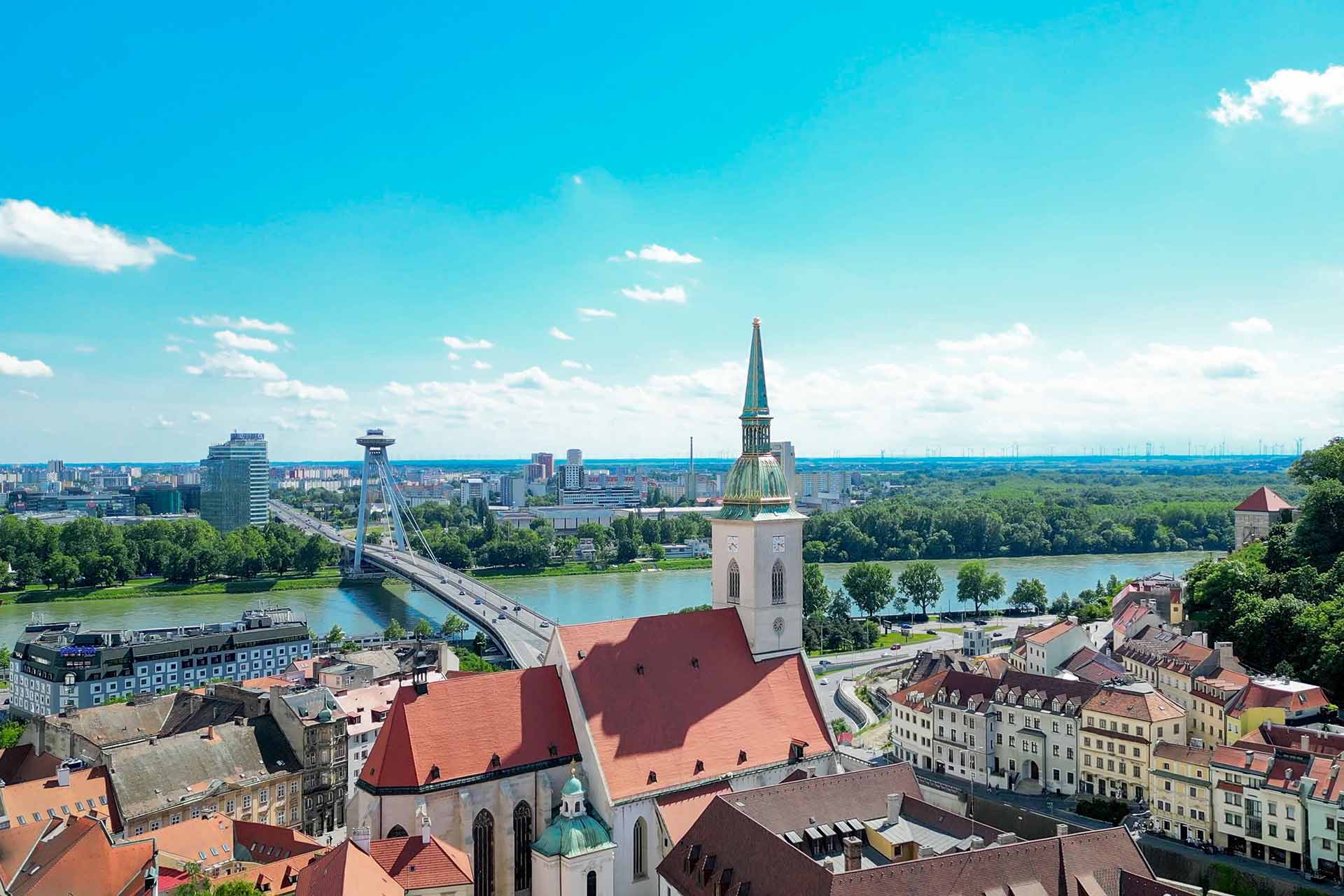
The capital of Slovakia remains the most popular destination among immigrants thanks to its strong economy, extensive transport connections, and higher salaries. Bratislava attracts professionals, entrepreneurs, and students seeking career opportunities and access to leading universities. As of 2026, the average gross monthly salary in the city ranges from EUR 1,900 to 2,200, while a one-bedroom apartment typically rents for EUR 700–1,050 per month, depending on the district and property type.
Košice
As Slovakia’s second-largest city, Košice offers a developed transport infrastructure, an international airport, and a growing labor market. Employment opportunities are available in manufacturing, logistics, IT, tourism, and trade. Living costs are noticeably lower than in Bratislava. In 2026, renting a one-bedroom apartment generally costs EUR 500–750 per month, while average monthly salaries range between EUR 1,400 and 1,600 gross.
Prešov
Located near Košice, Prešov is popular among families and retirees seeking a quieter lifestyle. The city offers affordable housing, less traffic, and good access to schools and public services. One-bedroom apartments typically rent for EUR 450–650 per month, while average salaries are approximately EUR 1,300–1,500 gross per month. Similar to other regional cities, demand is strongest for healthcare workers, engineers, IT specialists, and construction professionals.
Nitra
Nitra is one of Slovakia’s key industrial and university cities. Major employers operate in manufacturing, engineering, agriculture, and food production. The city continues to attract both domestic and foreign workers due to its stable labor market. Average monthly salaries are approximately EUR 1,400–1,600 gross, while apartment rents generally range from EUR 500 to 700 per month.
Trenčín
Situated near the Czech border, Trenčín has become an attractive destination for young professionals thanks to the presence of international companies and a growing economy. Living costs remain lower than in Bratislava, while employment opportunities continue to expand. Renting a one-bedroom apartment typically costs EUR 500–700 per month, and average monthly salaries range from EUR 1,400 to 1,600 gross.
Permanent Residence Renewal
Permanent residence status in Slovakia is granted for an unlimited period. However, the biometric residence card used as proof of identity is typically issued for 10 years for long-term permanent residents and must be renewed upon expiration. The renewal procedure is largely administrative and usually requires the holder to update their photograph and personal data with the police authorities. It does not involve a reassessment of the right to reside in the country.
After 8 years of legal residence in Slovakia, permanent residents may become eligible to apply for Slovak citizenship through naturalization. Applicants are generally required to provide a clean criminal record certificate and demonstrate knowledge of the Slovak language. The application is submitted to the competent district authority responsible for the applicant’s place of residence. The citizenship process may take up to 2 years.
Foreign nationals considering a permanent move to Europe may also wish to explore alternative immigration pathways available within the European Union. For eligible applicants from non-EU countries, certain citizenship restoration and ancestry-based programs remain available in several EU member states. These routes can provide access to EU citizenship and the right to live, work, study, and do business across the European Union. Depending on the specific program and individual circumstances, the process may take significantly less time than traditional naturalization. Consulting with specialists in international immigration law can help determine the most suitable option.
Content