Content
Foreign nationals can obtain Danish citizenship through the naturalization program. According to the legislation, in order to apply for a local passport, applicants must reside in the country for 6 to 9 years, depending on the initial grounds for immigration. Holders of Danish national identity documents are citizens of the European Union, as the Kingdom is part of the EU. Danish citizens can live, work, and conduct business in any member state without restrictions. The article below explains how to become a citizen of Denmark, how much it costs (including consular fees), and whether it is possible to track the status of an application after submitting it to the relevant authorities.
To navigate all legal requirements and avoid potential mistakes, applicants may seek assistance from professional migration lawyers. Experienced specialists help prepare and verify documents, ensure compliance with all eligibility criteria, and provide guidance at every stage of the application process, making the path to Danish citizenship more efficient and reliable.
Migration Legislation of Denmark
The legal framework governing the acquisition of Danish citizenship is set out in the Danish Nationality Act and the Circular Letter on Naturalization. According to the Constitution of the Kingdom of Denmark, holders of national identity documents have the right to:
- receive financial assistance from the state;
- freely express their thoughts orally or in writing, including in printed publications without censorship;
- employment within the country;
- establish official associations without prior permission from the authorities, such as organizations and unions;
- free education at school level;
- organize and participate in public assemblies without weapons and without prior authorization from the authorities.
Every citizen of Denmark is obliged to respect the sovereignty and independence of the kingdom, adhere to local values, and comply with the laws and Constitution.
Benefits of a Danish Passport
A Danish citizen’s identity document grants its holder the same rights and obligations as other EU citizens. Applicants have the right to live, work, or conduct business in the Kingdom, as well as in other EU member states without any restrictions.
Other opportunities provided by a Danish passport for applicants from non-EU countries include:
- an expanded list of countries available for visa-free travel;
- the right to legally reside in any EU country without the need for additional permits;
- participation in scholarship programs for higher education in Danish universities and other institutions across the European Union;
- access to qualified medical care in clinics throughout the EU;
- eligibility for social benefits provided by the Kingdom, including pensions, unemployment support, maternity benefits, and other forms of assistance.
Travel freely to over 170 countries
Ways to Obtain Danish Citizenship
Among foreign nationals, the most common ways to obtain Danish citizenship through naturalization include employment, starting a business, and family reunification with a legal partner or cohabiting partner. Depending on the chosen pathway, applicants may need to supplement the standard dossier with additional documents.
Employment
To apply for Danish citizenship on the basis of official employment, the applicant must find a suitable job and sign a contract with a local employer certified by the Danish Agency for International Recruitment and Integration (SIRI). The employment contract must specify an annual salary of at least approximately 74 000–75 000 EUR.
The applicant must obtain a temporary residence permit and a work permit — these documents are issued by the employer online and sent to the future employee. The basic citizenship dossier is supplemented with the employment contract and the work permit.
To become eligible to apply for citizenship, the applicant must reside in the country for at least 9 years and be employed during this period.
Business Activities
Entrepreneurs who establish a company in Denmark may apply for citizenship after 9 years of residence. The main conditions for obtaining an initial residence permit include approval of the business project by an expert panel of the Danish Business Authority and proof that the applicant contributes to the country’s economic life.
The government limits the number of applicants who can obtain residence permits through startup projects each. The standard dossier must be supplemented with proof of business activity and a work permit.
Marriage or Cohabitation
A legal partner of a Danish citizen or permanent resident may apply for a Danish passport. The required period of residence depends on the duration of the relationship and is shown in the table below:
| Duration of Marriage (months) | Required Residence Period (years) |
|---|---|
| 36 | 6 |
| 24 | 7 |
| 12 | 8 |
The applicant may apply for family reunification based on marriage, provided that both partners are at least 24 years old, or the younger partner has reached the age of 23.5.
In addition to the standard citizenship dossier, applicants must provide:
- a marriage certificate;
- proof of cohabitation (for unmarried partners);
- a declaration from the Danish citizen or permanent resident confirming financial responsibility for supporting the partner (for unmarried couples).
Requirements for Obtaining Danish Citizenship
To become a citizen of Denmark, a foreign national must meet a number of conditions:
- reside in the Kingdom for at least 6–9 years and be registered at a Danish address in the Central Person Register (CPR — Det Centrale Personregister);
- prepare and submit a complete set of documents in accordance with current legal requirements;
- live in the Kingdom with a permanent residence permit for at least 2 years prior to the date of applying for citizenship;
- pass a Danish language proficiency test;
- provide documented proof of no criminal record or offenses in both the country of origin and Denmark;
- submit confirmation of no outstanding debts to Danish public authorities (such as student loans, alimony, childcare payments, court fees, and others);
- have official employment for at least 3 years and 6 months within the last 4 years, or be self-employed for an equivalent period;
- participate in the official citizenship ceremony;
- sign a declaration of loyalty and allegiance to the Kingdom;
- not receive social benefits for more than 4 months within the 2–5 years prior to the citizenship application (the exact period depends on the type of benefit);
- pass an exam on Danish society, culture, and history.
How to Obtain Danish Citizenship: Step-by-Step Procedure
- Obtaining a long-term visa.
The applicant must apply to a Danish embassy or consulate abroad and request an entry permit valid for 6 months to 5 years (depending on the intended period of stay in the country). Prior to this, the immigrant needs to register in the ApplyVisa system, complete an online application form, pay the consular fee, print and sign the cover letter, and upload the required documents. The visa application dossier includes a passport valid for at least 6 months beyond the intended date of departure from the Kingdom, with at least two blank pages, as well as documents confirming the purpose of entry into Denmark (such as an employment contract, marriage certificate, or others). The ApplyVisa electronic service allows submission only for short-term visas (up to 90 days), so the need for a long-term visa must be indicated manually in the printed cover letter (using a red pen). The average processing time is 15–45 days. - Entry into the country and obtaining a residence permit.
Applications for temporary residence are handled by the Danish Immigration Service (for family reunification based on marriage or cohabitation) and SIRI (for residence permits related to employment or business activities). Applicants must submit their application before their visa expires by creating a case order ID through the official Nyidanmark online service and booking an appointment via the Borgerservice portal. The required dossier includes a copy of the passport, proof of payment of the state fee, evidence of sufficient financial means to stay in Denmark, and documents confirming the basis for residence (such as an employment contract, marriage certificate, or others). The processing time for a residence permit is approximately 1 to 9 months, depending on the grounds. - Passing the Danish language test.
Within 6–9 months after obtaining a residence permit, the applicant must pass a Danish language exam at a minimum level of A2. Registration for the test is carried out on the danskprove.dk website. The exam is conducted at the Language Center in Vejle or the Vestegnen Language and Competence Center. - Applying for permanent residence.
Foreign nationals who have lived in Denmark for 4 to 8 years (depending on the grounds for relocation) may apply for permanent residence through the Danish Immigration Service. Applications can be submitted before the temporary residence permit expires. Applicants must first submit an online application via the Nyidanmark service and schedule an appointment through Borgerservice. The permanent residence dossier includes proof of payment of the state fee, a certificate confirming Danish language proficiency or proof of completing primary education in Denmark, proof of income or a bank statement, and additional documents confirming the grounds for residence (such as an employment contract or proof of study). The average processing time is about 10 months. - Passing the citizenship test.
The applicant must register for the exam through a chosen language school. The exam lasts 45 minutes and consists of 40 questions covering Danish history, culture, and social conditions. To pass, the applicant must score at least 32 out of 40 points. Results are available within 3–4 weeks, and the certificate must be submitted by the applicant to the Danish Immigration Service. - Submitting the citizenship application.
Applications are processed by the Ministry of Immigration and Integration online through the Statsborgerskab service. The applicant must register using MitID (an electronic identification code obtained in advance via mitid.dk), complete the application form, and pay the state fee. After submission, the applicant receives a confirmation email. The average processing time is 17–22 months, and it is not possible to track the application status in advance. The Ministry issues citizenship bills twice a year — in April and October. If approved, the applicant receives an email invitation to participate in the «Constitution Ceremony», which is a mandatory stage in obtaining Danish citizenship. - Participation in the «Constitution Ceremony».
The ceremony is held at the municipality of residence in Denmark no earlier than 30 days and no later than 4 months after the adoption of the citizenship law. During the ceremony, the applicant must sign a declaration of adherence to the Constitution of the Kingdom of Denmark, demonstrate respect for local values, and shake hands with the mayor or another authorized official. At the end of the ceremony, the applicant receives a certificate of citizenship. - Obtaining a passport.
Based on the citizenship certificate, the applicant may apply for a passport at the municipality of residence. For individuals over 18 years old, the passport is issued for 10 years; for minors aged 2 to 18 — for 5 years; and for children under 2 — for 24 months. The processing time for the passport is 11–15 working days.
Required Documents for Obtaining Citizenship
To apply for Danish citizenship, a foreign national must prepare a dossier consisting of:
- an application form (completed online or in paper format);
- a copy of the first page of the passport containing the applicant’s personal data and photo;
- a certificate confirming successful completion of the citizenship test;
- a copy of the card confirming permanent residence status;
- a certificate confirming successful completion of the language exam;
- a receipt confirming payment of the state fee (for paper applications).
Parents of minor children applying for Danish citizenship must additionally provide:
- documents confirming parental rights (if the parents are not married);
- a declaration of secondary applicants (if children are included in the application of one parent);
- the child’s consent to obtain Danish citizenship (for applicants over 12 years old).
If the applicant is exempt from passing exams on Danish language, culture, history, and social conditions due to health reasons, the dossier must be supplemented with a medical certificate confirming this exemption. Documents issued outside Denmark must be translated into the official language of the Kingdom and apostilled.
To obtain a Danish passport, the applicant must provide a certificate of citizenship and a photograph. Photo requirements can be found on the official website of the Danish police.
Cost of Obtaining Danish Citizenship
The government of the Kingdom has not introduced immigration programs that allow applicants to obtain citizenship through investment. It is also not possible to legally purchase a Danish passport by submitting false documents or misleading information. Unlawful acquisition of citizenship may result in criminal liability, deportation, or a permanent ban on applying for a national identity document in the future.
The cost of obtaining Danish citizenship including consular fees and additional expenses, is presented in the table below.
Immigration to Denmark involves a range of mandatory expenses at different stages of the process. Initial costs start with visa application fees (from approximately 80–195 EUR) and residence permit applications, where fees are significantly higher — typically ranging from 250 EUR to 900+ EUR, and in 2026 work permit fees can reach around 900 EUR or more, depending on the grounds.
Further expenses include integration and legal stages: the Danish language test (from 390 EUR), permanent residence (from 650–900 EUR), and citizenship application fees — around 800 EUR.
After obtaining citizenship, additional costs include a passport (from 20 EUR for children up to 120 EUR for adults), as well as supporting expenses such as apostille certification (from 30 EUR per document) and translations (from 5 EUR).
Minor children are exempt from paying the state fee for citizenship issuance, provided they are included in their parents’ application.
Dual and Second Citizenship in Denmark
Denmark allows both dual and second citizenship. During naturalization, applicants are not required to renounce their original passport, provided that this is not required by the laws of their country of origin. Nationals of non-EU countries may retain their original citizenship when obtaining Danish nationality. Danish authorities do not prohibit their citizens from holding foreign national identity documents.
When relocating to Denmark and obtaining Danish citizenship, applicants acquire a second passport. Each of the countries involved will recognize the individual only as its own citizen and impose the corresponding legal obligations, such as military service or tax payments. When crossing borders, individuals are required to use the passport of the country they are entering.
Danish Citizen Passport
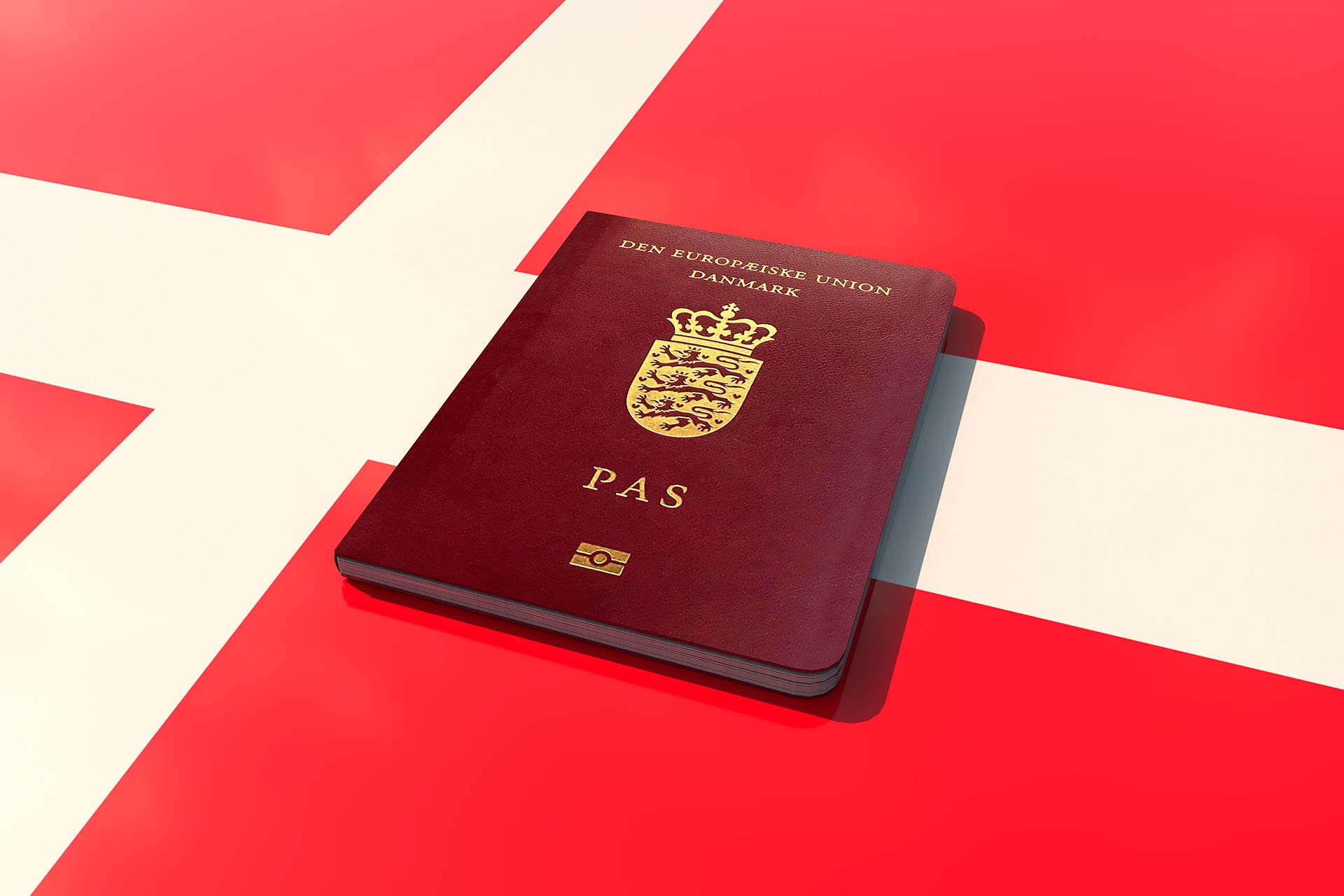
The Danish passport is issued in the form of a small burgundy booklet. The cover of the document contains the following information:
- the name of the issuing authority — European Union Denmark (Den Europæiske Union Danmark);
- the national coat of arms;
- the name of the document — passport («pas»).
Holders of a Danish passport can travel visa-free to 172 countries, including EU and Schengen Area member states, as well as countries such as the United States, Canada, the United Arab Emirates, the United Kingdom, Japan, and Qatar.
In addition, Danish citizens aged 15 and older can apply for a national identity card. This document is not mandatory. The cost of issuing the identity card is approximately 20 EUR.
Refusal to Grant Citizenship
A foreign national may be denied Danish citizenship or deprived of it after acquisition for the following reasons:
- submission of false information or a fraudulent application dossier;
- a criminal record abroad (including in the country of residence) or within the Kingdom;
- causing serious harm to Denmark’s national interests;
- lack of legal grounds for long-term residence in the Kingdom.
To avoid refusal when applying for Danish citizenship, it is advisable to seek support from legal professionals specializing in international law. Migration experts monitor all changes in Danish legislation and provide clients with up-to-date information on requirements, procedures, and key nuances of obtaining a national passport.
Reviews of Immigrants and Assistance in Obtaining Citizenship
According to reviews from applicants who have obtained Danish citizenship, the entire naturalization process in the country takes more than 10 years, taking into account the time required to obtain a residence permit, permanent residence, and a passport, which is considered a disadvantage. At the same time, one of the key advantages of immigration to the Kingdom is the ability to submit applications online.
Danish authorities allow applicants to schedule appointments with relevant government institutions and apply for residence permits, permanent residence, and citizenship through digital platforms, which significantly saves time and eliminates the need to wait in queues.
Denmark has been a member of the European Union since 1973. Due to the lengthy procedure, some immigrants prefer to obtain EU citizenship in other member states. In certain EU countries, the process of obtaining a national passport may take less time — approximately one year.
The main advantages and opportunities of holding citizenship of another EU country when relocating to Denmark include:
- employment and conducting business in the Kingdom without obtaining additional permits;
- access to higher education in local universities on a paid or free basis;
- eligibility for social benefits and other forms of state financial support;
- access to medical care in Danish clinics under a unified insurance system valid throughout the EU;
- visa-free travel within EU countries and the Schengen Area.
When immigrating to Denmark or another EU country, it is advisable to seek assistance from international law specialists. Experts help select the appropriate grounds for relocation, advise on which documents need to be prepared, translated, or apostilled, and explain how to correctly complete applications for residence permits, permanent residence, and citizenship. They also assist in developing a step-by-step plan for each stage of the immigration process.
Content