Content
Most immigrants can obtain Irish citizenship through naturalization after residing in the country for at least 5 years. Refugees and spouses of Irish citizens are eligible to apply after 3 years of residence in the Republic of Ireland. Without residency requirements, an Irish passport in 2026 can be obtained by descent or by birth.
The Republic of Ireland is a member of the European Union, and citizenship of this country provides numerous advantages across the EU. A passport holder has the right to live in any member state, work without additional permits, conduct business, receive education in prestigious institutions, benefit from social support and the reliable EU banking system, and travel freely around the world. Accordingly, EU citizenship obtained in another country may also serve as an alternative way for migrants to legalize their status in Ireland.
Applicants who want to simplify the process and avoid unnecessary complications can turn to professional migration lawyers for support. Specialists assist with evaluating eligibility, selecting the most appropriate path to citizenship, and preparing all required documents correctly. They also guide applicants through each stage of the procedure, clarify legal nuances, and help ensure compliance with Irish regulations, making the overall process more structured, efficient, and reliable.
Migration Legislation of Ireland
The rules for obtaining an Irish passport and the main requirements for applicants are defined by the Irish Nationality and Citizenship Act. Irish migration law allows dual citizenship, meaning that an immigrant applying for a passport may retain their existing national identity document.
The status of an Irish citizen grants all rights and freedoms established by the Constitution of the Republic. The primary obligation of a passport holder is to comply with local legislation, including the payment of taxes.
Benefits of an Irish Passport
Ireland ranks 3rd in the Global Peace Index, making it one of the safest countries with high social standards and strong protection of civil rights, all of which become available to those who obtain citizenship. An Irish passport allows its holder to freely travel, live, study, and work in any country of the European Union.
The main advantages of Irish citizenship include:
- freedom of travel, including access to 172 visa-free destinations — either without additional permits or with authorization obtained upon arrival;
- access to prestigious education in Ireland, any EU country, and the United Kingdom;
- legal employment without the need to obtain additional permits;
- assistance from Irish diplomatic missions abroad;
- the right to vote and be elected to local government bodies;
- the ability to conduct business freely in Ireland, any EU country, and the United Kingdom.
To discover new opportunities with EU citizenship
Ways to Obtain Irish Citizenship
Irish citizenship can be obtained by birth, by descent (right of blood), or through naturalization, which requires long-term residence in the country and integration into society. Any person born on the island (including Northern Ireland) before January 1, 2005, is eligible for citizenship.
For most immigrants, the most accessible way to obtain Irish citizenship is naturalization, which takes at least 10 years, taking into account the residency requirements and the time needed to process the application.
Applicants from non-EU countries may also consider obtaining citizenship of another EU member state, such as Romania, Bulgaria, or Poland, within a shorter timeframe — from approximately 12 months. To choose the most suitable pathway and gain rights equivalent to Irish citizens, it is advisable to consult with migration specialists.
By Right of Birth
A minor is considered an Irish citizen by right of birth if one of their parents held a British or Irish passport but passed away before the child was born. Citizenship of the Republic is also granted to individuals who do not meet the criteria described above but were born in the country and cannot claim a similar status in any other state.
By Right of Blood
Foreign nationals may obtain citizenship by proving Irish ancestry. This status is automatically available to individuals whose mother and/or father were born on the island and hold a passport of the Republic or have the right to obtain one. Citizenship by descent may also be granted to applicants who:
- had a parent who held an Irish passport at the time of the applicant’s birth but was not born in Ireland;
- have a grandparent who was born in Ireland.
These categories of applicants must register their details in the Foreign Births Register, which serves as the basis for obtaining an Irish passport and other identity documents. Applications can be submitted online via the official website of the Irish Department of Foreign Affairs by attaching civil status documents of relatives in the ascending line.
The application fee for adults is 278 EUR, while for minors it is reduced to 158 EUR. The average processing time is 6 to 9 months.
Naturalization
For applicants from non-EU countries who do not have Irish roots, the main way to obtain a passport of the Republic is through the naturalization program. This pathway may be based on various grounds, which directly affect the requirements imposed on applicants.
The key condition for applying for Irish citizenship through naturalization is long-term residence in the country. According to general rules, before submitting an application, the applicant must meet two requirements:
- legally reside in the Republic for a total of at least 5 years within the last 9-year period;
- continuously live in Ireland for 1 year immediately before applying.
The naturalization program is available to different categories of migrants who have legal grounds for residence in the country, including:
- graduates, postgraduate students, and researchers;
- employees;
- entrepreneurs;
- applicants with relatives in the country;
- retirees with sufficient financial means;
- volunteers and members of religious organizations.
Marriage to an Irish Citizen
Spouses and civil partners of Irish citizens may apply through a simplified naturalization procedure. This category of applicants must also meet the requirement of 12 months of continuous residence in the country before submitting the application, as well as the following conditions:
- be married or in a registered partnership for at least 3 years;
- have legally resided in the Republic for at least 3 years within the last 5 years.
Additional documents required include a marriage or partnership certificate, as well as proof of the spouse’s Irish citizenship (passport, naturalization certificate, etc.). The application form must be signed not only by the applicant but also by the spouse or partner.
Family Ties with an Irish Citizen
Children of foreign nationals who have already obtained Irish citizenship through naturalization may benefit from a simplified application procedure. In most cases, a 3-year period of residence is sufficient before applying.
Young adult applicants aged 18 to 23 may count part of their parents’ residence period in Ireland if their own period is insufficient for naturalization (for example, if they spent some time studying abroad). Applicants may apply for citizenship if they meet the following conditions:
- they move to Ireland together with their family;
- they are financially dependent on their parents;
- they attend school or enroll in a third-level institution in Ireland.
Applications for minors are submitted by their parents or legal guardians. Applicants aged 18–23 must complete a standard application form and may need to provide additional documents, such as a letter from an educational institution confirming enrollment and proof of sufficient residence of family members in Ireland.
Refugee Status
Foreign nationals who arrive in Ireland as refugees may apply for citizenship if they:
- are of legal age;
- have resided in the country for at least 3 years in total;
- have continuously lived in Ireland for 12 months prior to submitting the application.
In addition to the standard dossier, applicants must provide a letter confirming refugee status, an identity document, and a passport (if available). In some cases, the Immigration Service may request additional documents confirming residence or other grounds for the application.

Requirements for Obtaining Irish Citizenship
To become a citizen of Ireland, a foreign national must meet the following requirements:
- be of legal age (applications for minors are submitted by their parents);
- have good character;
- reside in the country for the required period under the conditions established by the naturalization program;
- be willing to attend the citizenship ceremony and take an oath to the Republic;
- intend to live in Ireland after obtaining a passport.
There is no strict legal definition of the term «good character», but when reviewing an application, the National Police and other law enforcement authorities assess the applicant’s background, including criminal records, traffic violations, ongoing investigations, and court proceedings. The application form includes a dedicated section where the applicant must disclose all such incidents and provide explanations.
It is assumed that after obtaining citizenship, the naturalized individual intends to reside in the Republic. If there is a need to leave the country temporarily, the passport holder must complete a Declaration of Intent to Retain Citizenship for the period of stay abroad.
All documents not issued in English must be translated in advance. Copies of the passport, birth certificate, and/or marriage certificate must be notarized before submission. The completed and signed application form, as well as the photographs attached to the dossier, must also be certified by an authorized person, such as a commissioner for oaths, a lawyer, or a notary.
How to Obtain Irish Citizenship: Step-by-Step Procedure
- Obtaining a long-term visa.
For nationals of non-EU countries, a mandatory requirement for entering and staying in Ireland for more than 90 consecutive days is obtaining a long-term visa. The application is submitted online through VFS visa centers, after which the applicant sends the document package by post, including proof of the grounds for staying in Ireland. The cost of a single-entry visa, excluding service fees, is 60 EUR, while a multiple-entry visa costs 100 EUR. Processing times may vary from 8 weeks to 6 months. - Registration and obtaining a residence permit.
Upon arrival in Ireland, the migrant must, within 90 days, book an appointment at the registration office in Dublin or at the nearest Garda Immigration Office outside the capital. The foreign national completes registration and pays a fee of 300 EUR, after which, within 10 working days, they receive by post a residence permit card (IRP), which confirms their legal stay in the Republic. - Extension of the residence permit and obtaining permanent residence.
Residence permits in Ireland are issued for a period ranging from 8 months to several years. To remain in the country legally for a longer period, it is necessary to apply for an extension 12 weeks before the permit expires. Residents living in Dublin can do this online, while others must contact the nearest Garda Immigration Office. The extension fee is 300 EUR. Foreign nationals who have legally worked and resided in the Republic for 5 years may apply for permanent residence, which is granted for 5 years. The application is submitted to the Immigration Service in Dublin, and upon approval, the applicant pays a fee of 500 EUR. - Submitting an application for citizenship.
If a foreign national has legally resided in Ireland for 5 years within the last 9-year period, including 365 days immediately before applying, they may apply for Irish citizenship through naturalization. The completed application form and supporting documents must be submitted by post to the Immigration Service Delivery under the Department of Justice. When submitting the application, the applicant pays a fee of 175 EUR, and upon approval, a certification fee is required — 950 EUR for adults and 200 EUR for children. - Waiting for a decision on citizenship.
The final decision on naturalization applications is made by the Minister for Justice, who has full discretion in approving or rejecting applications. Processing times may exceed 1.5 years. To check the status of the application or for any inquiries, applicants should contact the Immigration Service via the email address provided on its official website. - Taking the oath and obtaining an Irish passport.
After a positive decision, adult applicants are invited to attend a citizenship ceremony and take the oath. Prior to this, the applicant must pay the certification fee and submit their residence permit or permanent residence card, along with additional photographs, to the Immigration Service. After the ceremony, a naturalization certificate is issued (for children, it is sent by post). Based on this document, the applicant can apply for an Irish passport through the Department of Foreign Affairs.
Required Documents for Obtaining Citizenship
When applying for Irish citizenship through naturalization, foreign nationals must submit the following set of documents:
- a completed and certified application form No. 8;
- two photographs taken within one month prior to submission, signed on the back by an authorized person;
- a receipt confirming payment of the application fee of 175 EUR;
- copies of the international passport and all previously held travel documents with stamps confirming legal residence in Ireland;
- a valid passport of the country of origin or other identity documents;
- copies of the birth certificate (original and a version translated into English);
- a printout from the online residency calculator confirming the required period of residence for naturalization;
- a copy of the IRP card (residence permit);
- a marriage certificate with an Irish citizen (if applicable);
- a certificate confirming the absence of outstanding tax liabilities.
Applicants from non-EU countries must additionally confirm compliance with residency requirements by providing at least three different documents for each year of residence in the Republic. Acceptable proof may include:
- a P60 form (certificate of annual income);
- a rental agreement or mortgage statement;
- a report on received benefits or other social payments;
- bank statements showing daily transactions or utility payments;
- a letter from an employer with three recent payslips.
Supporting documents are assigned points (from 10 to 70), and the applicant must accumulate at least 150 points for each year of residence in Ireland. A similar system applies to identity verification, although it is easier to meet, as a valid passport from the country of origin typically provides the required 150 points.
Applications for minors are submitted by their parents. A different application form must be completed — No. 9 for standard naturalization or No. 10 if the child has Irish ancestry. The dossier must also include certified copies of the birth certificate, international passport with entry stamps confirming legal entry into the country, and the parent’s naturalization certificate (if applicable). Proof of the child’s residence in the Republic may include:
- original enrollment letters from schools or other educational institutions;
- confirmation of receiving child-related social benefits;
- vaccination records and/or pediatric medical records.
After obtaining citizenship, applicants must first apply for an Irish international passport rather than a national ID card. Individuals residing in the Republic can apply online or by post once they receive their naturalization certificate.
To obtain a passport, the applicant must provide the following documents:
- a completed application form;
- photographs;
- a naturalization certificate;
- a passport from the country of origin;
- a birth certificate;
- a copy of a public services card or another photo ID;
- proof of address and name (two separate documents, such as letters from public authorities, bank statements, utility bills, etc.);
- a marriage certificate (if applicable).
Online applications are processed within approximately 20 working days, while postal applications take at least 8 weeks.
Cost of Obtaining Irish Citizenship
The expenses associated with obtaining Irish citizenship include all mandatory payments made by the applicant, from the moment of applying for a visa up to receiving a passport. Total costs may increase due to notary and translation services, as well as travel, accommodation, and everyday expenses, which vary depending on the applicant. The mandatory fees and charges for obtaining citizenship through naturalization for one adult applicant are presented in the table below.
Immigration to Ireland involves several mandatory expenses at different stages of the process. Initial costs begin with a multiple-entry long-term visa, which remains approximately 100 EUR, followed by a residence permit, typically costing around 300 EUR. If the permit is issued for a limited period, extensions may be required, and two renewals can amount to approximately 600 EUR in total.
Further along the process, applicants are required to pay a citizenship application fee of about 175 EUR. In addition, there is a certification (naturalisation certificate) fee, which is significantly higher and can reach approximately 950 EUR for adults (for minors, this fee is usually lower — around 200 EUR).
After obtaining citizenship, additional costs include applying for a passport. The price depends on the type of document: approximately 75 EUR for a standard 34-page passport and around 100 EUR for a 66-page passport.
Current legislation of the Republic does not allow the purchase of a so-called «golden passport» in Ireland, meaning it is not possible to obtain citizenship through investment in real estate, business, or securities. As of February 15, 2023, the immigrant investor program, which previously allowed applicants to obtain residency through investment, has been officially closed.
Dual and Second Citizenship in Ireland
Ireland has not signed dual citizenship agreements with countries outside the EU, but this does not mean that holding multiple passports is prohibited. In such cases, second citizenship is not formally recognized by the country of origin. For example, a national of a non-EU country who obtains an Irish passport will still be recognized by their home country only as its own citizen.
Holding both Irish citizenship and citizenship of another country grants individuals full rights in each state, expanding opportunities for employment, education, business activities, travel, and more. However, holders of multiple passports must follow border control rules, meaning they should use the same travel document when entering and leaving the country of their citizenship.
Irish Citizen Passports
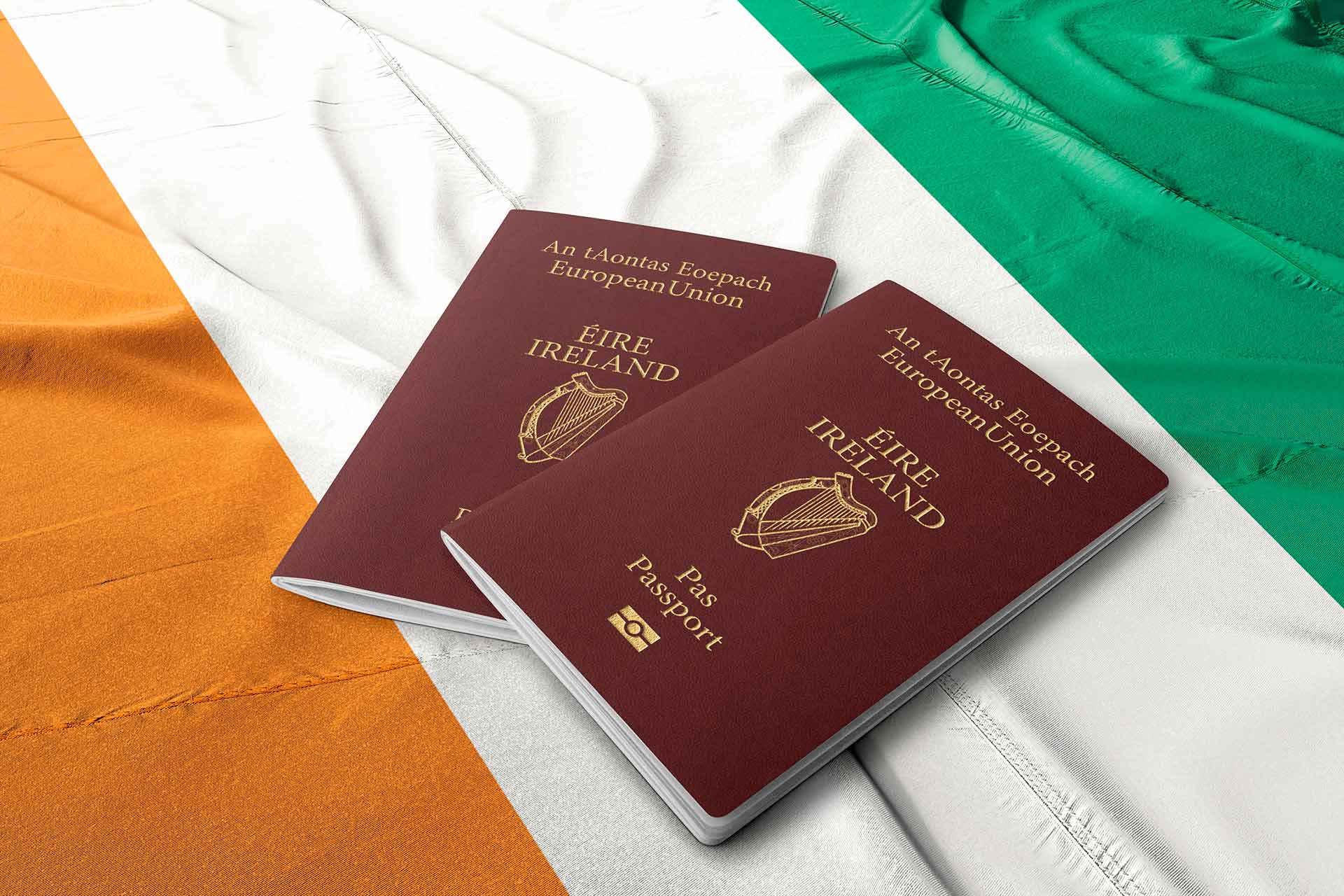
Since 2006, Ireland has issued biometric passports, which are designed as dark burgundy booklets. One of the main advantages of the document is the ability to travel visa-free to 116 countries worldwide, including the European Union, the Schengen Area, and countries in South America. In an additional 49 countries, entry permits can be obtained upon arrival. Electronic travel authorization is available for destinations such as the United States, Canada, the Republic of Korea, Australia, and New Zealand.
Applicants can choose between two types of Irish passports — 34 or 66 pages. For frequent travelers, the second option is more practical. Based on the passport booklet, it is also possible to obtain two additional travel documents:
- a passport card, suitable for travel within the EU, the European Economic Area, and Switzerland;
- a second passport for frequent business trips and travel.
Refusal to Grant Citizenship
The main reasons for refusal to grant Irish citizenship include:
- incorrectly completed application form;
- failure to provide a full set of required documents;
- insufficient period of residence for naturalization or lack of proof of residence in the country;
- legal issues, meaning failure to meet the «good character» requirement;
- justified concerns by the authorities that granting citizenship may pose a risk to national security.
Along with the refusal, the applicant is informed of the reasons for the decision. If the application is rejected on national security grounds, detailed explanations are usually not disclosed, although the applicant may request such information, and a special committee may approve its release.
The Immigration Service does not accept appeals, so the only way to challenge the decision is through the courts.
Applications for citizenship can be resubmitted at any time. Before doing so, it is recommended to consider the reasons for the refusal and consult with migration specialists.
According to reviews from individuals who have obtained an Irish passport, one of the main drawbacks of the procedure in recent years is the lengthy processing time. Instead of the standard waiting period of 12 months, applications may now take up to 2 years or longer. The initial increase in demand for legalization in the Republic was driven by Brexit, as many UK nationals sought to retain their rights and opportunities within the EU. In recent years, application processing has also been significantly slowed by the COVID-19 pandemic, followed by increased migration flows due to geopolitical instability.
As migrants note, to speed up legalization in Ireland, many foreign nationals choose to obtain citizenship of another EU country. With such a passport, no visa is required to enter the Republic, and individuals can work without additional permits, conduct business freely, receive social benefits, and enjoy almost all the same rights as Irish citizens, except for voting rights. In some EU countries, accelerated citizenship procedures may take from one year and do not require substantial financial investment. To select the most suitable pathway for legal residence in Ireland, it is advisable to consult with immigration specialists.
Content