Content
German citizenship is a legal relationship between an individual and the Federal Republic of Germany, based on the recognition of mutual rights, obligations, and responsibilities. A foreign national can become a citizen through naturalization, adoption, descent, marriage, or birth. The time required to obtain citizenship depends on the chosen grounds. As a rule, it is necessary to reside in Germany for at least 8 years with a residence permit while complying with national laws and regulations. For spouses of German citizens, this period is reduced to 3 years.
A German passport ranks third in the global mobility index. It allows its holder to travel, study, work, conduct business, and live not only in Germany but also in any European Union country without additional entry permits. Germany issues several types of passports designed for different purposes. The article below explains how and after how many years German citizenship can be obtained in 2026.
Obtaining German citizenship in 2026 involves a clear understanding of legal pathways, residency requirements, and procedural nuances, which can often seem complex for applicants from outside the EU. To navigate each stage correctly — from choosing the right basis to submitting documents and meeting all criteria — it is advisable to seek guidance from a qualified migration lawyer who can ensure a smooth and successful outcome.
What German Citizenship Provides: Pros and Cons
Holding a German passport grants numerous rights, the most important of which include:
- visa-free entry to 190 countries worldwide;
- the right to reside permanently in any EU country;
- unrestricted access to the German labor market;
- the opportunity to study at leading European universities;
- the right to conduct business in Germany and other EU countries;
- the right to vote and participate in local elections.
Among the disadvantages is the restriction on dual citizenship. This legal status is generally available only to children who acquire citizenship at birth from their parents, if one of them is a foreign national or holds multiple citizenships.
Citizenship Law
The acquisition of German citizenship is regulated by Articles 16 and 116 of the Constitution, as well as by the Federal Citizenship Act. One of the mandatory stages is passing a language test and demonstrating knowledge of the country’s history and culture. After completing all stages, the applicant receives a citizenship certificate, an identity card (Deutscher Personalausweis), and a German international passport (Reisepass).
Travel freely to over 170 countries
Ways to Obtain German Citizenship
There are several pathways to immigrate to Germany, each requiring compliance with specific conditions and the laws of the state.
Naturalization
Obtaining a passport through this method is possible after long-term legal residence in Germany, as well as integration into German society. The applicant must meet the following criteria:
- reside in the country legally for 8 years (successful completion of an integration course reduces this period to 7 years);
- have proficiency in the German language at level B1 or higher;
- demonstrate knowledge of the legal system, history, as well as the specific features of the country’s culture (passing the test is mandatory);
- have sufficient financial means for self-support;
- renounce previous citizenship;
- be a law-abiding resident (a criminal record may lead to rejection of the application for German citizenship).
The Naturalization Process Includes the Following Stages:
- legal residence with a residence permit;
- obtaining permanent residence;
- preparation of documents;
- passing the naturalization test;
- payment of state fees;
- submission of the citizenship application;
- obtaining a passport.
The state fee for submitting a citizenship application is 255 EUR, and 51 EUR for minors.
Birth
A child born in Germany automatically receives German citizenship if one of the parents holds a German passport. The connection to the state must be confirmed before the person reaches the age of 23. Children born to German parents abroad on or after January 1, 2000, will receive citizenship only if they are registered with the competent German authority within 12 months of birth.
German citizenship is also granted to children of foreigners who have legally resided in the country for at least 8 years with a residence permit. A child under 18 at the time of adoption automatically acquires citizenship through legal adoption by a German parent in accordance with German law. No additional fees are charged for obtaining citizenship in this case.
Descent
Regardless of the place of birth, a foreigner may obtain a German passport if at least one of their parents, grandparents, great-grandparents, or great-great-grandparents held German citizenship. The applicant may also restore German citizenship by descent if:
- they were born in a lawful marriage and their father was a German citizen;
- they were born on or after January 1, 1975, to married parents (if one of them held a German passport);
- one of their ancestors was a German citizen whose citizenship was revoked during the Nazi regime in 1938 for political, racial, or religious reasons;
- they were born out of wedlock, but their mother was a German citizen at the time of birth;
- they were born on or after July 1, 1993, to divorced parents, but their father held a German passport.
Marriage
For foreigners wishing to obtain German citizenship through marriage, the general rules and stages of naturalization apply (the difference lies only in the timeframes). Spouses may apply for citizenship after 3 years of legal residence in Germany. Additionally, the couple must have been married or in a registered partnership for at least 2 years at the time of application.

Employment and Study
Individuals planning to move to Germany for employment purposes may obtain citizenship after 8 years of continuous residence in the country. First, the foreign national must obtain a work permit and the appropriate visa. Upon arrival in Germany, a temporary residence permit (Aufenthaltstitel) is issued. The permit is limited to the duration of the employment contract (usually 3 years) and can be extended. Subsequently, it is necessary to obtain permanent residence (granted for an unlimited period), which then serves as the basis for applying for a German passport.
For migration to Germany for educational purposes, a foreigner needs proof of enrollment in a higher education institution and a visa. After entering the country, a residence permit is issued for the entire period of study at a German university. The permit can be extended for job search, which may later allow obtaining permanent residence and, eventually, citizenship.
Investment and Business
Currently, Germany does not offer investment programs for obtaining citizenship. A foreigner may become a permanent resident and obtain a passport if they engage in entrepreneurial activity and make a significant contribution to the country’s economy.
First, the Chamber of Commerce must approve the applicant’s business plan, after which it becomes possible to apply for a self-employment visa at the German embassy. This permit allows entry into the country for the purpose of starting a business. Upon arrival in Germany, the applicant receives a temporary residence permit, issued for three years and subject to renewal. Entrepreneurs may also benefit from an accelerated path to citizenship through naturalization, which requires residing in the country for at least six years.
Research Activity
A foreign national has the right to conduct research in Germany after obtaining the appropriate authorization or concluding an agreement with a research institution. Based on one of these documents, an EU Blue Card for highly qualified specialists or a residence permit is issued, which can be extended for up to 9 months for the purpose of job search in the country.
Permanent residence is granted to the following categories:
- foreigners who have graduated from a German higher education institution and have worked in the country for two years (in accordance with their qualifications);
- scientists with expert knowledge;
- research personnel holding senior positions.
Thus, a researcher may subsequently obtain German citizenship based on employment and permanent residence in the country.
Refugee Status
Persons seeking asylum in Germany are granted a temporary residence permit (Aufenthaltsgestattung) for a period of 3 years on political or humanitarian grounds. Subsequently, refugees may apply for permanent residence if they meet certain conditions, including:
- sufficient means of subsistence;
- proof of German language proficiency.
Therefore, upon meeting the requirements, this category of individuals may eventually apply for citizenship. This can be done through naturalization (based on employment or other grounds).
Late Resettlers
If a person is a descendant of ethnic Germans from countries outside the European Union, they are automatically granted citizenship under the late resettlers program. First, it is necessary to obtain Spätaussiedler status in the country of residence. To do this, the applicant must collect documents confirming the ancestor’s nationality and their family relationship, and then submit an application to the Federal Office of Administration of Germany.
After the application is approved, the ethnic German may enter Germany and register at the reception center for late resettlers, where a document is issued confirming the legal entitlement to obtain German citizenship.
Immigration Program for Jewish Applicants
German law allows Jewish individuals to immigrate to the country provided certain conditions are met. As a rule, the Federal Office approves the applicant’s request for entry if they:
- have Jewish roots and practice Judaism;
- are nationals of countries outside the EU (excluding certain regions) or have resided there without citizenship since at least January 1, 2005;
- are able to financially support their residence in Germany on a permanent basis;
- have German language proficiency at a minimum level of A1 (a certificate in accordance with the international CEFR standard is required);
- can demonstrate that they will become active members of the Jewish community in the country.
Family members of the applicant may relocate together with them, provided that the couple has been married for at least 3 years.
EU Citizenship
A holder of a European Union passport can freely live, work, conduct business, and study in any country within the Union. In addition, EU citizens engaged in entrepreneurial activities benefit from special initiatives and support schemes that provide financial assistance for startups.
Applicants from non-EU countries also have the opportunity to obtain citizenship through accelerated programs. For detailed guidance on the procedure, it is advisable to consult a migration specialist.
Required Documents for Obtaining German Citizenship
The migration authority to which the application is submitted usually specifies exactly which documents are required. As a rule, the applicant must provide:
- a completed application form;
- a passport or identity document;
- a birth certificate;
- proof of financial means (bank statement);
- a marriage certificate (if applicable);
- a German language certificate (minimum level B1).
Depending on the chosen pathway to citizenship, additional documents may be required. It is recommended to consult a legal specialist, as a migration expert can assist in compiling the dossier, check it for errors, and, if necessary, request missing documents from official archives.
Refusal to Grant Citizenship
Authorized authorities may reject an application for citizenship if the applicant fails to meet all requirements or provides false information. There are also other possible reasons, including:
- Criminal record. The applicant must not have any ongoing criminal proceedings (either within the country or abroad) or administrative violations at the time of applying for citizenship. Minor penalties in the form of fines do not constitute an obstacle to naturalization.
- Fictitious marriage. A marriage of convenience is one of the most common reasons for refusal, as it represents a direct violation of the law. If a court recognizes the marriage as fictitious, the applicant may be fined or sentenced to imprisonment for up to 3 years.
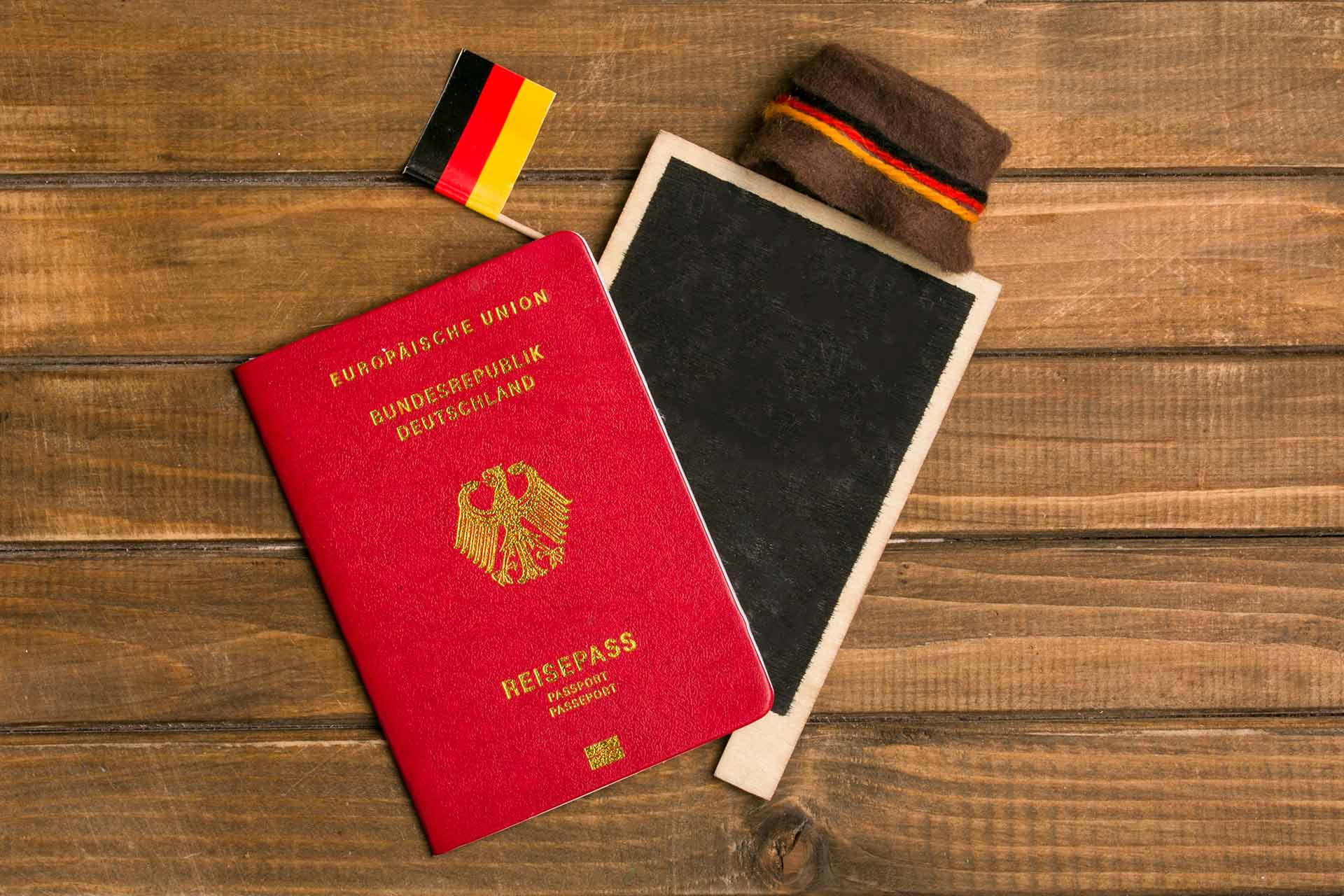
German Passport: Appearance and Types
In Germany, there are several types of identity documents designed for different categories of applicants. Let’s take a closer look at each of them:
- Standard international passport. This document contains 32 pages and is valid for 10 years for individuals over 24, and 6 years for applicants under 24. The cost is 60 EUR and 37.5 EUR respectively.
- Temporary passport. If a foreign national needs to travel urgently but has not yet received a permanent identity document, they may obtain a temporary passport. Its validity does not exceed 1 year, and the cost is 26 EUR.
- 48-page passport. Issued upon request to individuals who travel frequently, this document includes additional pages for visas. The cost is 82 EUR for applicants aged 24 and over, and 59.5 EUR for those under 24.
- Children’s passport. This document is issued without a chip, so children are not required to provide fingerprints when applying. It is available for children under 12 years old and is valid for up to 1 year. The cost is 13 EUR.
Procedure for Obtaining a German Passport
To obtain a German passport, the applicant must go through the following stages:
- Preparation of the dossier.
It is necessary to collect a full set of documents and complete the application form. It is important to prepare all required certificates, as failure to do so may result in a refusal to issue the passport — therefore, it is advisable to entrust this stage to specialists. - Submission of the application.
The application for a passport is submitted to the residents’ registration office (Bürgeramt) at the place of residence or to any other citizens’ office. In the latter case, an additional fee is charged. The staff of the authorized authority will inform the applicant when the identity document can be collected. - Issuance of the passport.
The processing of the document usually takes at least 2 weeks from the date of application. An appointment for passport collection can be scheduled online, by email, or by phone — all necessary information is available on the official website of the relevant authority.
Second Citizenship in Germany
To obtain German citizenship through naturalization, an applicant is generally required to renounce their previous passport. Therefore, for individuals from countries outside the European Union, obtaining a second citizenship on this basis is not possible. Exceptions apply only to refugees who, due to persecution, cannot renounce their original citizenship without risking their lives.
Dual citizenship implies the existence of a relevant international agreement between countries. Since Germany does not have such agreements with a number of non-EU states, obtaining bipatride status for applicants from these countries is also not possible.
Assistance in Obtaining a Second Citizenship
The process of obtaining German citizenship involves numerous details that are often overlooked, even by official authorities. Professional specialists can help applicants obtain European citizenship as efficiently as possible. Cooperation typically includes the following stages:
- Preparation of the dossier.
A legal expert compiles the full set of documents required for submission to the authorized authority and, if necessary, assists in obtaining any missing certificates. - Obtaining residence and permanent residence permits.
Migration specialists oversee all stages of the process — from application review to the issuance of the relevant permits. - Obtaining citizenship status.
The application is submitted to the local authority. A legal advisor accompanies the applicant during the oath-taking procedure and the issuance of the citizenship certificate. Subsequently, specialists assist with obtaining a national ID card and other required documents.
Organizing relocation abroad usually requires significant time and effort. By using the services of migration specialists, applicants gain a wide range of advantages, including support at every stage of the process. Legal experts assist in preparing the dossier and help build a clear, structured plan for moving to Germany.
Moreover, applicants often find it challenging to prepare for the oath ceremony due to the large amount of new information. Company specialists provide the necessary materials to ensure that the client can confidently take the oath without facing additional questions from the migration officer.
Content