Content
Polish citizenship grants the right to live in the country without restrictions, work officially, access healthcare services, and receive full protection from the state. Citizens of Poland can live, work, and run businesses in all 27 EU countries, vote in elections, purchase real estate without restrictions, and study free of charge at public universities across Europe.
A Polish passport confirms that its holder is a citizen of the Republic of Poland. It allows visa-free travel to 182 countries and provides simplified relocation opportunities within the European Union. Several pathways are available for obtaining Polish citizenship and a passport, including repatriation, naturalization, and citizenship through the Pole’s Card. Below, we will explore all available options, their characteristics, timelines, and which pathway is considered the simplest.
Obtaining Polish citizenship may involve a number of legal complexities, document checks, and procedural requirements. Migration lawyers help applicants choose the most suitable pathway, prepare documents correctly, and navigate every stage of the process, significantly increasing the chances of successfully obtaining a Polish passport and EU citizenship.
Conditions for Obtaining Polish Citizenship
Polish citizenship can be obtained if an applicant meets certain rules and requirements established by the following laws:
- The Citizenship Act (2009) — the main legal document defining the categories of individuals eligible to belong to Polish society.
- The Pole’s Card Act (2007) — regulates the confirmation of belonging to the Polish nation.
- The Foreigners Act (2013) — governs employment opportunities for migrants.
- The Repatriation Act (2000) — regulates repatriation procedures.
A Polish passport may be obtained through the following pathways:
- after 3 years of legal residence with a stable income and knowledge of the Polish language;
- by a minor resident after one of the parents acquires Polish citizenship;
- by birthright;
- through a presidential grant of citizenship;
- through marriage to a Polish citizen;
- through repatriation.
Naturalization in Poland
One of the most common ways to obtain Polish citizenship is through long-term residence in the country. This option is suitable for those planning to live in Poland permanently. According to the established rules, an immigrant must first obtain a residence permit and later apply for citizenship.
To become a Polish citizen through naturalization, applicants may qualify under the following conditions:
- holding a residence permit based on long-term employment for at least 3 years, while also having a stable income and a long-term housing agreement;
- obtaining Polish citizenship through marriage, provided the marriage has lasted for at least 3 years and the applicant has legally resided in Poland for at least 2 years before the official registration of the relationship;
- receiving refugee status under specific humanitarian circumstances and legalizing stay through a settlement permit or permanent residence card;
- residing in Poland with permanent residence obtained through the Pole’s Card or on the basis of close relatives of Polish origin.
At the same time, obtaining Polish citizenship through naturalization also has certain disadvantages. The process can be relatively lengthy and may take up to 10 years or more. However, for some categories of applicants this period can be significantly reduced — for example, holders of the Pole’s Card may obtain citizenship after just one year of legal residence in Poland.
Travel freely to over 170 countries
Repatriation to Poland
One of the ways to obtain Polish citizenship is through ancestry. Repatriation programs are available to applicants from non-EU countries whose close relatives are Polish citizens or of Polish origin. A person may qualify for repatriation if they permanently resided before January 1, 2001, in certain regions of Central Asia or other territories defined by Polish legislation.
This pathway may also be available to applicants who meet additional conditions, including:
- students continuing their education in master’s degree programs who are citizens of EU member states or family members of such citizens, provided they submit the application within 12 months after graduation;
- foreigners residing in Poland on the basis of permanent residence, with a stable income and either owned housing or a long-term rental agreement;
- foreigners who obtained a residence permit in Poland as spouses of repatriates and who can confirm regular income and accommodation.
Proof of income and housing is not required for minors, pensioners, or individuals entitled to disability benefits in Poland.
The mandatory application package includes a completed application form, a passport, and documents confirming Polish origin. At the same time, the authorities may request additional supporting documents if necessary.
Citizenship Through the Pole’s Card
Since 2019, following amendments to the Pole’s Card Act, the document can be obtained by applicants of any nationality, provided they can confirm Polish ancestry.
Holding a Pole’s Card allows a person to apply for Polish citizenship after residing legally in Poland for at least one year. Once the required documents are prepared, the applicant must schedule an interview at a Polish consulate or embassy. To successfully complete the interview, it is necessary to demonstrate basic knowledge of the Polish language, as well as familiarity with the country’s history and culture.
Pole’s Card holders have the right to work officially, run a business, receive free education, and access emergency healthcare under conditions similar to those available to Polish citizens. Minor children may also obtain the Pole’s Card if their parents already hold one.
Applications for the Pole’s Card are typically processed within 4 to 12 months. The card itself is issued for 10 years and can later be renewed for the same period.
How to Obtain Citizenship Through Naturalization: step-by-step guide
This program is suitable for individuals who do not have Polish ancestry, regardless of nationality, including applicants from non-EU countries. Citizenship through naturalization can be obtained on the basis of a residence permit. Depending on the grounds for application, different timeframes and requirements apply.
One of the possible pathways is education followed by official employment in Poland. Starting a business may also serve as grounds for applying for citizenship, provided the business demonstrates effective operation. At the same time, investors who simply wish to purchase real estate or invest in an already existing company are not considered eligible applicants for citizenship. To obtain Polish citizenship through naturalization, applicants must follow several steps.
Obtaining a Polish National Visa (Type D)
A foreign national must first obtain a national immigration visa in order to stay legally in Poland. This visa also allows travel within the Schengen Area for up to three months during each six-month period. Entry permits are issued to students, employees, and holders of the Pole’s Card.
Obtaining a Temporary Residence Card
After arriving in Poland, applicants from non-EU countries must submit documents for a residence permit. It is important to have a registered place of residence and a stable official income that can be verified. A temporary residence card is usually issued for up to one year with the possibility of renewal.
Holding a residence permit allows a person to enter and leave Poland freely under visa-free travel rules. Residents also gain the right to purchase real estate, officially register businesses, and conduct entrepreneurial activities under simplified procedures.
To obtain a residence card, the following documents are required:
- a standard application form completed in Polish;
- proof of the grounds for stay in the country, such as an employment contract;
- a valid international passport;
- proof of accommodation in Poland;
- 4 photographs taken within the last six months (3.5 × 4.5 cm);
- proof of payment of the state fee.
Obtaining a Permanent Residence Card
After 4 years of continuous residence in Poland on the basis of a temporary residence permit, an applicant may apply for permanent residence. Depending on the individual case, additional documents may be required, but the standard list for obtaining permanent residence in Poland generally includes:
- a valid international passport;
- 4 high-quality color photographs (3.5 × 4.5 cm);
- documents confirming the intention to reside permanently in Poland;
- a birth certificate;
- completed application forms in Polish submitted in two copies;
- proof of payment of the state fee, if applicable.
Obtaining a Passport
According to the standard naturalization procedure, an applicant for a Polish passport must reside in the country for at least 4 years with permanent resident status. Only adults are eligible to obtain EU citizenship through this pathway. A passport is usually issued within one month after submitting the full set of required documents.
Naturalization Timeframes
The minimum required period of residence before applying for citizenship depends on the grounds for immigration:
- employment — from 2 years;
- marriage to a Polish citizen — from 3 years;
- refugee status — from 2 years;
- permanent residence card — from 1 year.
Accelerated Procedure for Obtaining Polish Citizenship
It is not possible to buy a Polish passport, but obtaining Polish citizenship through a simplified procedure may be available with the support of experienced migration specialists.
- Contacting a Migration Company.
International migration lawyers provide applicants with consultations and full legal support throughout the citizenship process. Specialists can also conduct a free assessment of available documents to determine whether the applicant has Polish ancestry. - Preparing Documents and Scheduling Submission.
Migration experts assist with preparing the application package, which is then submitted to the nearest Polish consulate in the applicant’s country of residence. - Interview and Submission of Documents.
The interview is conducted with a consul, who evaluates the applicant’s knowledge of the Polish language, as well as familiarity with the history and culture of Poland. Lawyers help applicants prepare for the interview process. After successfully completing the interview, the applicant signs a declaration confirming their connection to the Polish nation. - Receiving the Pole’s Card.
The Pole’s Card is issued by the same consulate where the interview and document submission took place. On the basis of this document, and with the assistance of migration specialists, the applicant can obtain a national visa. - Obtaining Permanent Residence.
After arriving in Poland, the applicant submits documents for permanent residence and receives a permanent residence card. Following one year of continuous residence in the country, the resident becomes eligible to apply for citizenship. - Obtaining a Polish Passport.
The applicant must apply to the local voivodeship office at the place of registration in order to receive a citizenship certificate. On the basis of this certificate, Polish identity documents and a passport can be issued.
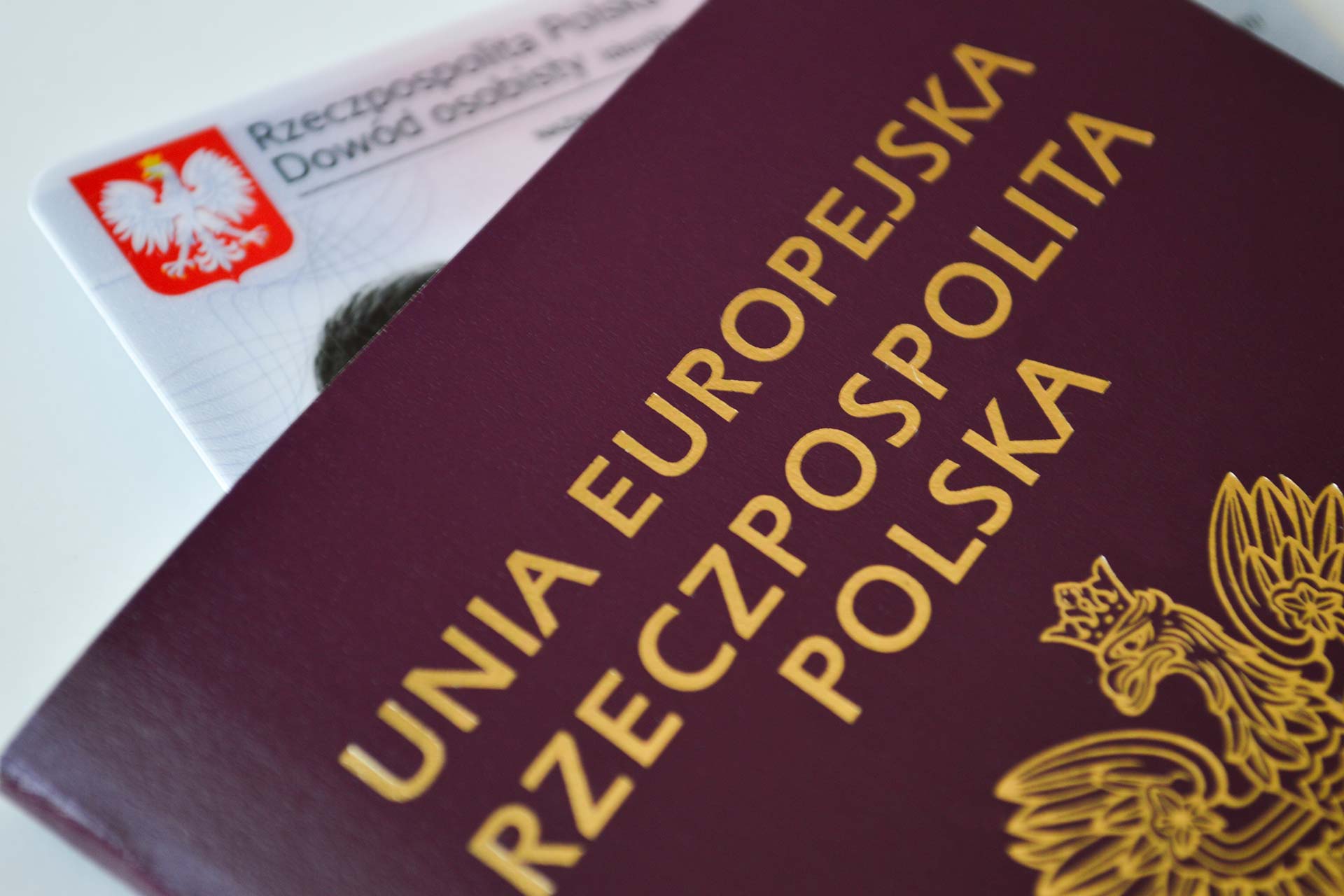
The Polish national ID document is issued in the form of a plastic biometric card containing personal information about the holder. The international Polish passport follows the EU standard in booklet format and includes personal data, a signature, a photograph, and an embedded chip containing biometric information. The cost of a full legal support package typically starts from 3,500 EUR.
What a Polish Passport Provides for Applicants from Non-EU Countries
For applicants from non-EU countries, a Polish passport grants the same rights enjoyed by citizens of Poland and other European Union member states, including:
- access to a developed healthcare system under a unified insurance policy;
- the right to purchase land, residential, commercial, and other types of real estate without restrictions;
- access to business and personal loans with relatively low interest rates;
- visa-free travel throughout the European Union and the Schengen Area;
- the right to work officially in any EU country without additional work permits;
- the opportunity to receive education in the EU free of charge with a diploma recognized across Europe.
A Polish passport provides not only legal status within the European Union, but also broader opportunities for work, travel, education, and long-term residence across Europe. Since the citizenship process often involves document verification, proof of ancestry, residence requirements, and communication with government authorities, many applicants turn to migration lawyers or specialists in international law for professional guidance. Expert support helps make the procedure more structured, reduces the risk of refusal, and allows applicants to navigate every stage of obtaining Polish citizenship with greater confidence and clarity.
Content